
Project Details
CDMA Decoder: Deep Dive into Spread-Spectrum Decoding
CDMA (Code Division Multiple Access) is a spread-spectrum technique where multiple users share
the same frequency and time, but are separated by code. Each transmitter multiplies its data bit
(+1 or -1) with a pseudo-random chip sequence. The receiver sees the sum of all active users.
Decoding works because each satellite code is almost orthogonal to the others: the correct code-phase alignment yields
a strong correlation peak, while wrong satellites/phases stay near zero.
Mathematically, the receiver computes a circular cross-correlation:
R(s, o) = Σ c[i] * g_s[(i + o) mod L],
where c[i] is the incoming chip sequence, g_s is satellite s's Gold code,
o is code phase offset, and L = 1023. In this project, a satellite is declared active
when |R(s, o)| exceeds a threshold. The sign of R maps to the transmitted bit
(positive => bit 1, negative => bit 0).
This repository implements the same decoder in three variants: C++ reference, C unoptimized, and C optimized. They all target the same problem: identify active satellites, decoded bit values, and code-phase offsets from one GPS-style frame.
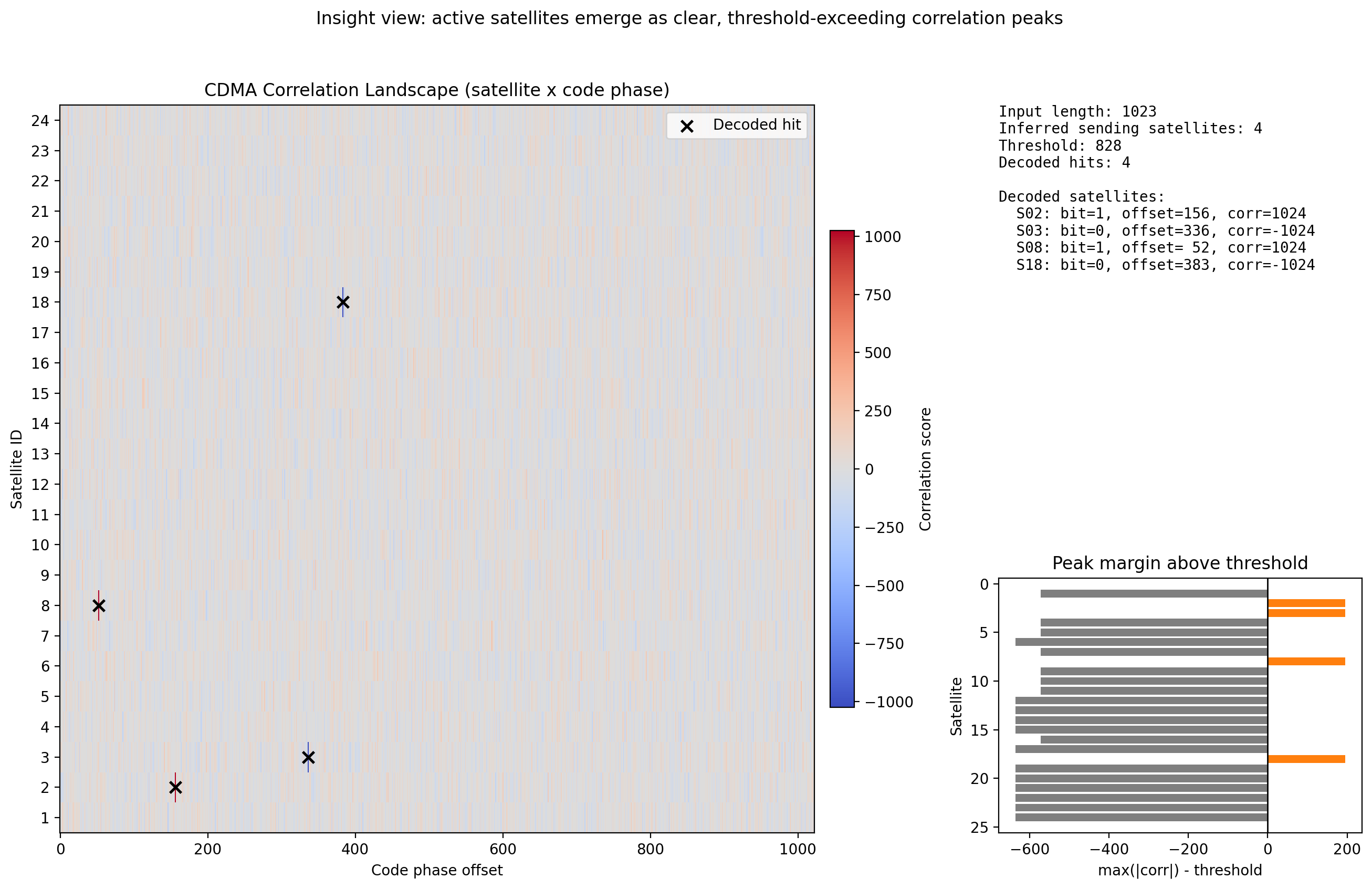
The key insight is not only which satellites were detected, but why: active satellites produce isolated, threshold-exceeding peaks at specific code-phase offsets.
The correlation landscape below shows all 24 satellites across all 1023 offsets. Most values cluster near zero. The decoded satellites stand out as strong positive/negative peaks with large margin above threshold.
For deeper exploration, the interactive version is embedded here. It allows zooming and hovering over any satellite/offset pair:
C++ reference implementation
The C++ version keeps the design clean and close to the algorithm: generate one Gold sequence per satellite, correlate over offsets, and stop on the first valid peak for that satellite.
const uint16_t peak = sequence.size() - MAX_DEVIATION * (satelliteCount - 1);
for (size_t offset = 0; offset < sequence.size(); ++offset) {
    int32_t sum = 0;
    for (size_t i = 0; i < sequence.size(); ++i) {
        const size_t index = (i + offset) % sequence.size();
        sum += sequence[index] ? chipSequence[i] : -chipSequence[i];
    }
    if (std::abs(sum) > peak) {
        // satellite detected, bit is sign(sum), offset is code phase
        break;
    }
}
Gold code generation in C++ uses two 10-bit shift registers and XOR taps:
bool motherFirst = motherSequences.first.back();
bool motherSecond =
    motherSequences.second[registerSumIndices.first] ^
    motherSequences.second[registerSumIndices.second];
sequence.push_back(motherFirst ^ motherSecond);
C unoptimized implementation
The unoptimized C variant is a direct procedural port of the C++ logic. It explicitly allocates all 24 generated sequences and then performs the same modulo-based circular correlation loop.
bool* sequences[NUM_SATELLITES];
for (i = 0; i < NUM_SATELLITES; i++) {
    sequences[i] = malloc(CHIP_SEQUENCE_LENGTH * sizeof(bool));
    CDMA_GenerateSequence(sequences[i], CHIP_SEQUENCE_LENGTH, i);
}
CDMA_decode(sequences, chipSequence, maxElement, correlationResults);
for (offset = 0; offset < CHIP_SEQUENCE_LENGTH; offset++) {
int32_t accumulatedSum = 0;
for (i = 0; i < CHIP_SEQUENCE_LENGTH; i++) {
size_t index = (i + offset) % CHIP_SEQUENCE_LENGTH;
accumulatedSum += (sequence[index] ? chipSequence[i] : -chipSequence[i]);
}
}C optimized: what was optimized and why it matters
The optimized C version focuses on CPU and memory efficiency while preserving decoder behavior:
- Precomputed Gold sequences: runtime sequence generation is removed.
- Doubled sequence layout: each code is stored with length
2*L, so offset access avoids modulo in the inner loop. - Pointer-based access: contiguous reads improve locality and reduce indexing overhead.
- Early exit: decoding stops once expected active satellites are found.
if (numCorrelationsFound == numSendingSatellites) {
    break; // early exit
}
const int32_t* goldSequencesPtr =
    (const int32_t*)goldSequences + j * 2 * CHIP_SEQUENCE_LENGTH;
for (offset = 0; offset < CHIP_SEQUENCE_LENGTH; ++offset) {
    int32_t accumulatedSum = 0;
    for (i = 0; i < CHIP_SEQUENCE_LENGTH; ++i) {
        accumulatedSum += goldSequencesPtr[i + offset] * chipSequence[i];
    }
}
Visualization and validation
To explain decoder behavior, I built a Python visualization pipeline that reconstructs all Gold sequences, computes the full correlation matrix, marks detections, and verifies parity against executable output.
chip = load_chip_sequence("C++/gps_sequence.txt")
sender_count = np.max(np.abs(chip))
threshold = 1023 - 65 * (sender_count - 1)
seqs = generate_all_gold_sequences(1023)
corr = correlation_landscape(chip, seqs)
detections = detect_from_landscape(corr, threshold)
This makes the project transparent from theory to implementation: you can trace every decoded satellite bit back to a concrete correlation peak and compare algorithmic trade-offs across C++, C unoptimized, and C optimized versions.
Project information
- Category Program
- Scope Project at HKA
- Project Date January, 2021
- Tech stack C++, C, CMake, Python (NumPy, Matplotlib, Plotly)
- Project URL Github